Jade

Java

  • Java is a statically typed, OO, platform independent programming language

Data types

// Datatypes
short a = 5;  // 2 bytes
int a = 5;  // 4 bytes
long a = 5;  // 8 bytes
float a = 5.0f;  // 4 bytes
double a = 5.0;  // 8 bytes
byte a = 1;  // 1 byte
boolean a = true;  // 1 byte
char a = 'h'  // 2 bytes
 
// Autoboxing
Integer i = 1;
  • Two types
    • Primitive - basic data types that store simple data on the stack
    • Reference - contain references to values and/or other objects or the special value null
  • Autoboxing
    • Each primitive has a full class implementation that can wrap it. Java can do the conversion automatically - autoboxing

Variables

int a;  // Default is 0
  • Default value for all primitives is 0, false for booleans, \u0000 for char
  • If the variable is defined in a method, we must assign a value before we can use it.
  • float/double overflow results in Infinity whereas integers wrap around.
  • An identifier
    • Cannot be a reserved keyword
    • Can start with only $, _ or an alphabet

Control structures

// if else
if () {}
else if () {}
else {}
 
// switch case
switch () {
	case: {
		break;
	}
	default: {}
}
 
// while loop
while () {}
do {} while ()
 
// for loop
for (int i = 0; i < 10; i++) {}
 
for (int i : arr) {}
for (Entry<String, Integer> entry : map.entrySet()) {
    entry.getKey();
    entry.getValue();
}
 
List<String> arr = new ArrayList<>();
arr.forEach(item -> item);
 
// Labelling
outer: for (;;) {
	inner: for (;;) {}
}

Classes

// Defn
class Car {
    // Fields
    String type;
    String speed;
 
    // Constructor
    Car(String type, String speed) {
        this.type = type;
        this.speed = speed;
    }
    
    // Methods
    int increaseSpeed(int increment) {
        this.speed = this.speed + increment;
        return this.speed;
    }
}
 
// Instance
Car focus = new Car("Ford", "Focus", "red");
focus.increaseSpeed(5);
  • Class properties are described by fields, which contain the state of objects of the class, and its behavior is described using methods.
  • Every class has an empty constructor be default which initializes all fields with default values. (String to null)
  • While classes are translated during compile time, objects are created from classes at runtime which are instances of classes.
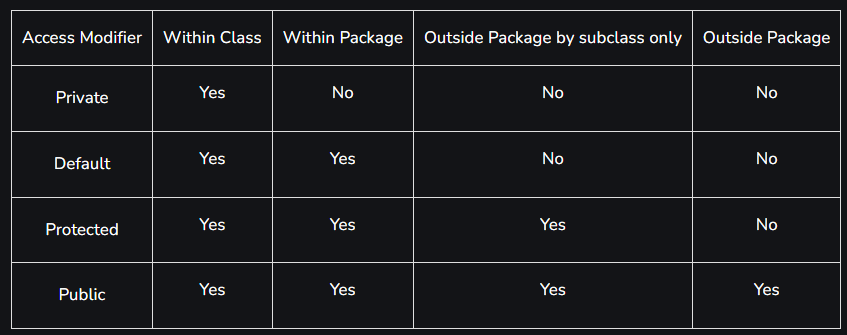
  • Access modifiers
    • public - anywhere
    • private - same class only
    • default - same package only (default)
    • protected - same class and subclasses only
    • Pasted image 20240819195420.png

Collections

// Arrays
int[] numbers = new int[100];  // Empty list that can contain 100 elements
numbers = {1, 2, 3};

Packages

// Defn
package com.example.user;
 
// Usage
import com.example.user.*;
import com.example.user.HelloWorld;
  • Packages are used to group related classes, interfaces and sub-packages.
  • Helps in avoiding name collision and access control
  • It is recommended to put each new type in a package. If not, they are part of the default package
    • We lose the benefits of having a package structure and we can’t have sub-packages
    • We can’t import the types in the default package from other packages
    • The protected and package-private access scopes would be meaningless
  • Naming
    • All lower case
    • Period delimited
    • Reversed domain + sub package name
  • In case of a name conflict, use the fully qualified name

Program structure

public class SimpleAddition {
    public static void main(String[] args) {
        int a = 10;
        int b = 5;
        double c = a + b;
        System.out.println( a + " + " + b + " = " + c);
    }
}
  • The basic unit of a Java program is a class
  • For a class to be executable, it needs a main method
  • The args in the main method is the command-line arguments
  • We can define more the one main method in an application but we have to specify which method the JVM uses with a MANIFEST.MF file

Execution

javac SimpleAddition.java
java SimpleAddition
  • We first compile the source code to generate the bytecode (.class file) using javac
  • Then execute the bytecode using java